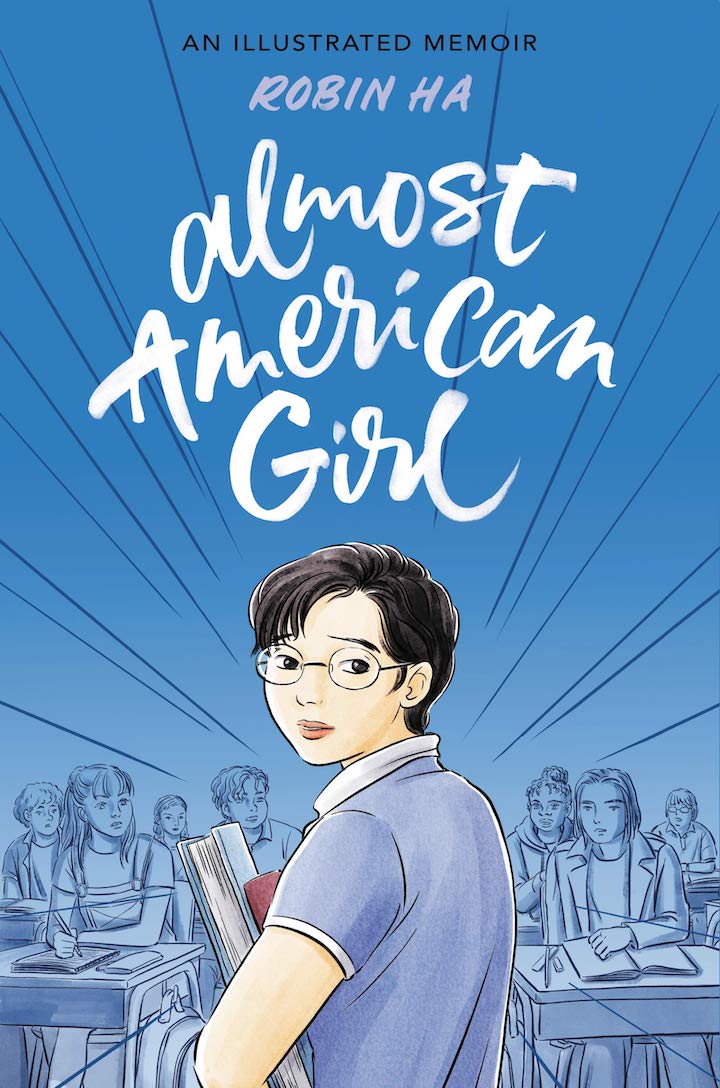
Though more of an immigrant story than a TCK one, Almost American Girl has many strong TCK themes throughout the graphic novel. This true story is told as a memoir in pictures by Korean American author Robin Ha. Robin is suddenly moved to Alabama, USA from Seoul, Korea without even being able to say goodbye to her friends or bring her most precious belongings. She just thought they were going on vacation! Now she has a new step-family who don’t seem to like her and she can’t understand anyone at her new school.
Despite the culture shock, her loneliness and her anger at her mother for suddenly uprooting her, Robin eventually makes friends and finds solace in comics and manga. She gets better at English and is surprised to find so many signatures in her yearbook at the end of the year. But when her mother’s new marriage fails, they move yet again.
In Virginia, Robin finds more international kids like herself and even Korean friends, and finally feels like she belongs. At the end of the book she visits Korea for the first time since she left and realizes that the country she has been longing for doesn’t even feel like home any more. She has changed and so have her old friends in Seoul. “I didn’t exactly fit in Korea or America,” she thinks to herself. And that was okay.

This TCK parenting book takes a proactive approach to raising children, looking at how early childhood experiences and the emotional health of the parents contribute to raising healthy kids. Lauren Wells emphasizes the very real effects that childhood experiences, especially trauma, exert in adult health.
This book is also very practical. It will teach parents how to address trauma in the moment so that the grief doesn’t pile up and have lasting effects. Different talking points, activities and conversation starters are given for children of different ages so that you have the tools you need to address issues or proactively build resilience throughout your child’s whole growing up.
If I had a complaint about this book it would be that she can focus on one segment of TCK tendencies and ignore the others. For example, she focuses heavily on the “chameleon” nature of TCKs to blend in, and less on “screamers” who refuse to conform or “wallflowers” who try to disappear during transitions. As a screamer myself, I felt rather underrepresented. She also focuses on MKs who get the itch to move every few years but I know many MKs who didn’t experience this at all. For some, they attach themselves to the first place they can settle into and never want to leave again. These TCKs may need a different kind of help.
Overall, this is an excellent book for parents, especially those parents of young TCKs who wish to build a solid foundation for their kids’ emotional health. It’s rather comprehensive without dragging itself out. Highly recommend.
Misunderstood is a decent introductory book for those looking to better understand TCKs, written for TCKs themselves, parents, and those who care for TCKs (like counselors or those who work for the parents’ organizations). It goes into detail about the different types of TCKs (like military brats, missionary kids, etc.) and the pros and cons of different schooling options while outside your passport country.
The book is based on interviews that the author has conducted on a large sample of TCKs and included many quotes and stories to accompany each section. While this lends credibility to her book, it can also be misleading.
Being a TCK caregiver, I know many TCKs who would disagree with the generalizations that she makes. It seems she interviewed TCKs who identify strongly with their overseas experiences and have struggled in adapting to their passport cultures. She said every TCK she interviewed claimed reentry was “a particularly difficult experience” (pg. 211). I know several TCKs who would disagree and say the experience was not very difficult for them. Many TCKs adapt well to their passport culture and do not strongly identify with being a TCK, though these are probably the TCKs least likely to volunteer to be interviewed about TCK experiences.
So while the book as a whole is a good summary of TCK experiences in general, one has to keep in mind that her interview sample was likely skewed and many TCKs would say her generalizations about TCK beliefs and experiences do not fit them.
A memoir of a missionary kid processing her experience of growing up abroad, and especially of going to boarding school as a young child, “Letters Never Sent” takes the reader through a process of healing and seeking closeness with God. Written in the form of letters to her parents (the original title is more apt: “Letters I Never Wrote”), this is her story from early childhood through adulthood as the discovery that pain and purpose can co-exist begins to bring comfort & healing.
While unmasking some of the darker sides of missions and especially the family separations that often go along with it, Van Reken still honors the good in her experiences and how much she loves her and parents and loves God. She doesn’t look at her experiences in black and white but still gives helpful advice to those who are on a similar journey towards recovery and to parents of TCKs who don’t want to repeat her parents’ mistakes.
Naomi is a 12-year old Canadian girl who is forced to move to a small northern town in Japan and no one asked her if she wanted to go. She left behind her friends and her beloved grandparents and her dog Billy and she is not happy about it. Everything is strange in Japan and she’s seen as a strange outsider, not even able to read or communicate at first.
Gradually, Naomi begins to learn about Japanese festivals and foods and customs. She becomes friends with Midori, a Japanese girl her age who used to live in the US. And from there Naomi’s world begins to open up even more and she learns to love Japan and the people in her village. As she learns about her new home, the readers also get to learn about the language, writing and history of Japan. It’s a sweet, calming read and I was sad to put the book down.
This is the first book in a trilogy.
This novel follows Adelaide, who has lived her whole life in a small Ethiopian village with her anthropologist father, disengaged mother and two younger sisters. When she’s told that her family is moving to South Carolina you can’t help but cringe in thinking about this naive village girl leaving her village for the first time. Adelaide isn’t excited about it either and vows to come back and marry her childhood sweetheart.
Most of the story follows Adelaide’s friendship with the African American students who have enrolled in her white school. It’s 1964 in the South of the US and racial tensions are high. No one can understand why a white girl is friends with the black students and Adelaide can’t understand why it’s such a big deal since she has always been friends with black Africans.
This TCK novel follows some typical themes of culture shock and reentry which were rather extreme for Adelaide as she is basically as sheltered as someone can be. I also loved how Kindberg looked at racism and how white expats can be embracing of other cultures overseas and racist in their own countries. The end of the story also shows how difficult and different it can be to go back to where we grow up as an adult and realize we don’t fit like we used to.