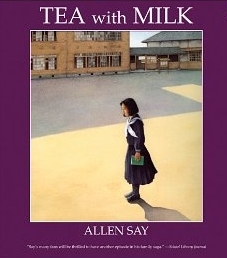
This is the true story of the author’s mother. The American-born daughter of Japanese parents, she returns to Japan when her immigrant father gets homesick for his homeland. A high school graduate with an American mindset, she faces culture shock as she re-enters Japanese society. She struggles with the expectations that she will be a proper young Japanese lady, and eventually leaves home to try to find her own place in this country. Eventually she discovers a way to blend her American experiences with her life in Japan. While the format of this book is a (beautifully illustrated) children’s picture book, it’s content is more applicable to older children and teens. It would make a fabulous discussion starter for older kids and teens – particularly about re-entry into the U.S.
Reading level: age 5 – high school
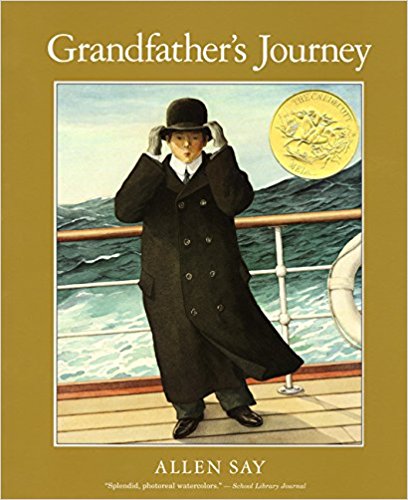
This is the true story of the author’s grandfather who left Japan to explore the USA and eventually made a home there with his wife and daughter. He holds fond memories of Japan, however, and eventually returns there when his daughter is nearly grown (her story is told in Tea with Milk). There he longs again to return to California, but the war prevents this. So he tells his grandson about his life in America, and when his grandson grows up, he goes there himself, and discovers he, like his grandfather, loves both countries and longs to be both places at once. Like all Allen Say’s books, it is beautifully illustrated with full-page watercolors.
This book is great for children, but it can also be used at reentry retreats for teens. We sometimes read this to our teenagers at reentry and the last words are very powerful: “The funny thing is, the moment I am in one country, I am homesick for the other.”
Reading level: age 5 – high school
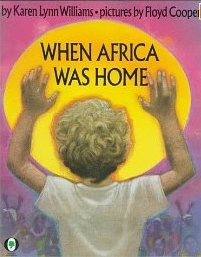
Peter, a white American, is entirely at home in a Malawian village. He slides down anthills in the hot sun, chews sugarcane with his friend Yekha, and runs with the goats. When he has to go to America with his parents, he feels displaced, and waits patiently until their joyful return to the village, where he is once again at home. Williams evokes Africa as the ultimate playground, a place of warmth, belonging, and freedom.
Cooper’s luminous paintings in oranges, yellows, greens, and blues contribute to this image, as they show Peter and Yekha playing against a background of shimmering heat. The warmth of that country is contrasted starkly with the cold of winter in America. Peter’s story tends to lose its flow in the descriptions of daily life. However, continuity is provided by frequent use of the phrase, “when Africa was home…” The book is successful as a read-aloud, but the print is also large enough for independent reading.
Reading level: age 4-7 years.
Though usually recommended for adolescents or young adult MKs returning to North America for high school or college, this book is also for parents. It provides practical tips and insights to help children adjust to the initial move overseas, develop a strong identity, and return to the U.S. In addition to practical things such as driving, managing money and finding a job, issues such as alcohol and drug use, sex and AIDs are addressed.
There is lots of advice from MKs to both MKs and parents. The format will appeal to most teens. The book is over 20 years old so some of the practical information is outdated (e.g. telephones). Also certain important topics (e.g. cell phones or internet access) are absent as they were not used when this book was written. Nevertheless, much of the material remains relevant despite changing times.