The following chapters are many and stand alone, but also work well as a cohesive whole.
- Congratulations: You’re Raising a TCK! by Patricia Linderman
- Bombay baby: Pregnancy Abroad by Karryn Miller
- Right Next Door But Worlds Away: Our Adoption Story by Gretel Backman Patch
- Overseas Schools: A Parent’s Guide by Anne Allen Sillivan
- British School Overseas by Katie Jagelski
- French School Overseas by Rory Burnham Pickett
- Looking at the Boarding School Option by Rebecca Grappo
- Homeschooling in the Foreign Service: Doubly Unusual! by Amy Macy
- U.S. College Admission and the Foreign Service Teen by Francesca Huemer Kelly
- Comparing Advanced Placement and International Baccalaureate
- Gifted and Talented Children in the Foreign Service by Leah Moorfield Evans
- The Art of Acquiring a Second Language by Jen Kirk Dinoia
- Living Overseas When Your Child has Special Needs by Lauren Salazar
- When Kids Struggle Overseas by Rebecca Grappo
- Raising a Child with Attention Deficit/Hyperactivity Disorder by Laurie Kelleher
- Prepare Before You Hit the Air: Going Abroad with your Special Needs Child by Michelle Grappo
- Staying Safe While Living Abroad by Shelly Goode-Burgoyne
- Saying Cheers In three Languages: Foreign Service Kids Talk About Alcohol by Laura Tasharski
- Tandem Couples and Kids by Amy and Joshua Archibald
- The Single Parent and the Foreign Service by Tamara Shie
- How to Manage Parenting and Working in the Foreign Service by Marcelle Yeager
- Joy for a Dime and a song: A Case for a Washington, D.C., Tour with Children by Laura Merzig Fabrycky
- An Unacompanied Tour by Amanda Fernandez
- Mothering Across the Miles by Anne Aguilera
- Transitions with Kids by Lexy Boudreau
- Traveling with Kids by Ana Gabriela Turner
- Starting New by Miriam Engstrom
- The Ties that RemindL Maintaining a Connection to the Home You Left Behind by Julie Tully
- Tame that Clutter and Make your Move Easier! by Tara Kniew-Fraiture
- The Oxygen Mask – Mindfulness for Foreign Service Parents by Jodi Harris
- Patchwork Parenting, Quilted Kids by Laura Tasharski
- Resources for Parents in the Foreign Service by Nicole Schaefer-McDaniel
Misunderstood is a decent introductory book for those looking to better understand TCKs, written for TCKs themselves, parents, and those who care for TCKs (like counselors or those who work for the parents’ organizations). It goes into detail about the different types of TCKs (like military brats, missionary kids, etc.) and the pros and cons of different schooling options while outside your passport country.
The book is based on interviews that the author has conducted on a large sample of TCKs and included many quotes and stories to accompany each section. While this lends credibility to her book, it can also be misleading.
Being a TCK caregiver, I know many TCKs who would disagree with the generalizations that she makes. It seems she interviewed TCKs who identify strongly with their overseas experiences and have struggled in adapting to their passport cultures. She said every TCK she interviewed claimed reentry was “a particularly difficult experience” (pg. 211). I know several TCKs who would disagree and say the experience was not very difficult for them. Many TCKs adapt well to their passport culture and do not strongly identify with being a TCK, though these are probably the TCKs least likely to volunteer to be interviewed about TCK experiences.
So while the book as a whole is a good summary of TCK experiences in general, one has to keep in mind that her interview sample was likely skewed and many TCKs would say her generalizations about TCK beliefs and experiences do not fit them.
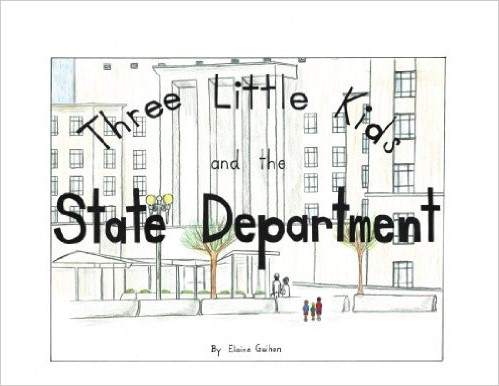
A series of hand-drawn cartoons chronicles the real-life experiences of 3 boys whose dad works for the U.S. State Department. We meet them as small children when the family sets out for their first assignment in Mauritania, and the book follows them through postings in France, Cote d’Ivoire, the U.S., and Turkey where the last two boys graduate from high school. The simple, kid-friendly text, and nicely-drawn pictures describe the boys’ everyday lives (where/what they like to play, what type of school they attend, etc.) as well as sharing some of their adventures visiting interesting places in each of the countries. Though perhaps more enjoyable for expat kids who have plenty of similar adventures, the book does not assume that readers have prior knowledge of diplomacy, and starts by explaining diplomats & embassies. That makes it something that any kid could read to learn more about the lives of Third Culture Kids (TCKs) from the diplomatic sector.
Reading level: age 6-9
“Collect memories, process the move and celebrate the future with activities, ideas, and games in this workbook.”
This workbook for kids preparing to move internationally was created by an expat mom of four US foreign service TCKs. It is designed to help pre-school & elementary kids to record their memories of the old home, prepare to move, and discover their new home.
This workbook covers different topics than many similar books, and this makes it especially good for TCKs, who are clearly the intended audience. One page, however, talks about Americans who have moved throughout history, which may seem odd to TCKs from other countries.
Reading level: 6 to 11 years
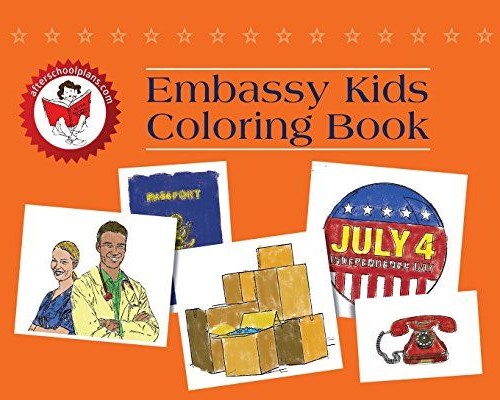
This coloring book was created specifically for US diplomats’ kids, though others who go to the embassy for visas may find some images familiar. Kids color their way through an American Embassy, learning who works in an embassy, what they can expect if they visit, and what life might be like living abroad. It includes forty full-sized coloring and activity pages. Pictures look like they were computer-created from photos, which works better with some subjects than others.
Reading level: 7 to 9 years